
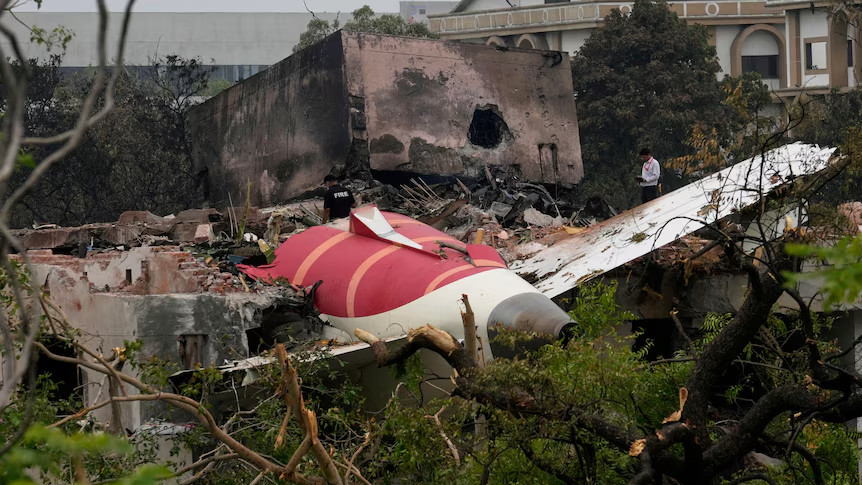
Engine Failure After Takeoff: A U.S. aviation safety expert states such switches are protected and cannot be moved accidentally.
Engine Failure After Takeoff: This raises critical questions about pilot actions and procedural adherence during takeoff. Investigators believe incorrect switch movement may have led to sudden engine shutdown.
The findings raise serious concerns about cockpit procedures and human error. Following analysis of the Boeing 787’s black boxes. The Air Current reported possible improper movement of fuel control switches in the cockpit.
This raises concerns over potential pilot error or procedural failure in the moments before the AI-171 crash. May have played a role in the Air India AI 171 crash. The aircraft, en route to London, crashed moments after takeoff on June 12, slamming into the BJ Medical College hostel building in Ahmedabad.
The devastating incident claimed 260 lives, including 241 passengers and crew on board and 19 people on the ground, prompting urgent scrutiny of cockpit procedures and mechanical safeguards.
Understanding Fuel Control Switches: A Key Engine Management System
Fuel control switches on the Boeing 787 Dreamliner are critical components used to start or shut down the engines while on the ground. Each engine has its own switch with two positions: RUN (to allow fuel flow) and CUTOFF (to stop it).
These switches are located just below the throttle levers inside a fuel control module and are safeguarded by protective brackets to prevent accidental movement.
Additionally, each switch features a metal stop lock that requires the flight crew to lift and deliberately move the switch, ensuring intentional operation during engine start-up or shutdown procedures.
How do these switches functions?
Engine Failure After Takeoff: Moving a fuel control switch from RUN to CUTOFF during flight would immediately stop fuel flow to the associated engine, leading to a sudden engine shutdown and loss of thrust, according to The Air Current. This action also disables the two electrical generators powered by each engine, cutting off power to several aircraft systems and cockpit displays.
Such an event can severely compromise flight control and situational awareness, especially at low altitude, making recovery extremely difficult. However, the Boeing 787’s advanced fly-by-wire flight control system is designed to automatically compensate for thrust imbalances, adjusting control surfaces to stabilize the aircraft even if one engine loses power.
This automation enhances safety and handling, allowing pilots to maintain control during asymmetric thrust conditions—though it may not fully mitigate risks during low-altitude or dual-engine failure scenarios.
The Boeing 787’s fly-by-wire system automatically adjusts the aircraft’s flaperons, ailerons, and rudder to maintain straight and stable flight during asymmetric thrust conditions, and pilots receive tactile cues to aid in response.
However, according to The Air Current, black box data has not yet confirmed whether the fuel control switches were moved intentionally, accidentally, or due to another factor prior to the loss of thrust. U.S. aviation safety expert John Cox emphasized that accidental activation is highly unlikely, stating, “You can’t bump them, and they move,” due to built-in safeguards on the switches.
According to Reuters, the investigation into the Air India crash has not identified any immediate mechanical failures, and no safety bulletins or operational changes have been issued for the Boeing 787 fleet. The investigation is being led by India’s Aircraft Accident Investigation Bureau (AAIB) with support from the Indian Air Force, HAL, and U.S. technical experts.
This joint effort aims to uncover the root cause of the Air India AI-171 crash through a detailed analysis.
National Transportation Safety Board (NTSB)—the official agency responsible for investigating incidents involving aircraft designed and manufactured in the United States.
The Aircraft Accident Investigation Bureau (AAIB) has submitted its preliminary report on the AI-171 crash to the Ministry of Civil Aviation this week, marking an important step in the ongoing investigation into the tragic incident.
National Transportation Safety Board (NTSB), as well as representatives from Boeing and GE—has successfully retrieved and downloaded data from the aircraft’s black boxes at the AAIB Lab.
This collaborative effort is critical, as the flight data recorder (FDR) and cockpit voice recorder (CVR) contain essential information to determine the sequence of events leading to the AI-171 crash involving the Boeing 787.
A panel of Parliamentarians is set to review safety measures in the civil aviation sector, with a particular focus on the recent Air India AI-171 crash. A parliamentary committee has invited key industry stakeholders and government officials to appear for questioning on Wednesday as part of its review into the state of civil aviation safety.
The session is expected to address aviation safety protocols, the effectiveness of current regulatory oversight, and the preliminary findings from the investigation into the Air India AI-171 crash. The move signals growing concern among lawmakers about ensuring accountability and strengthening safeguards in India’s aviation sector.
This parliamentary review underscores growing public and governmental concern over flight safety and operational standards in India’s rapidly expanding aviation industry.